How to Fill a Tall Raised Garden Bed (Without Spending a Fortune on Soil)
A 29-inch raised bed needs nearly a cubic yard of fill. Here's the layered hugelkultur method we use to cut soil costs by 60% — and still grow great vegetables.
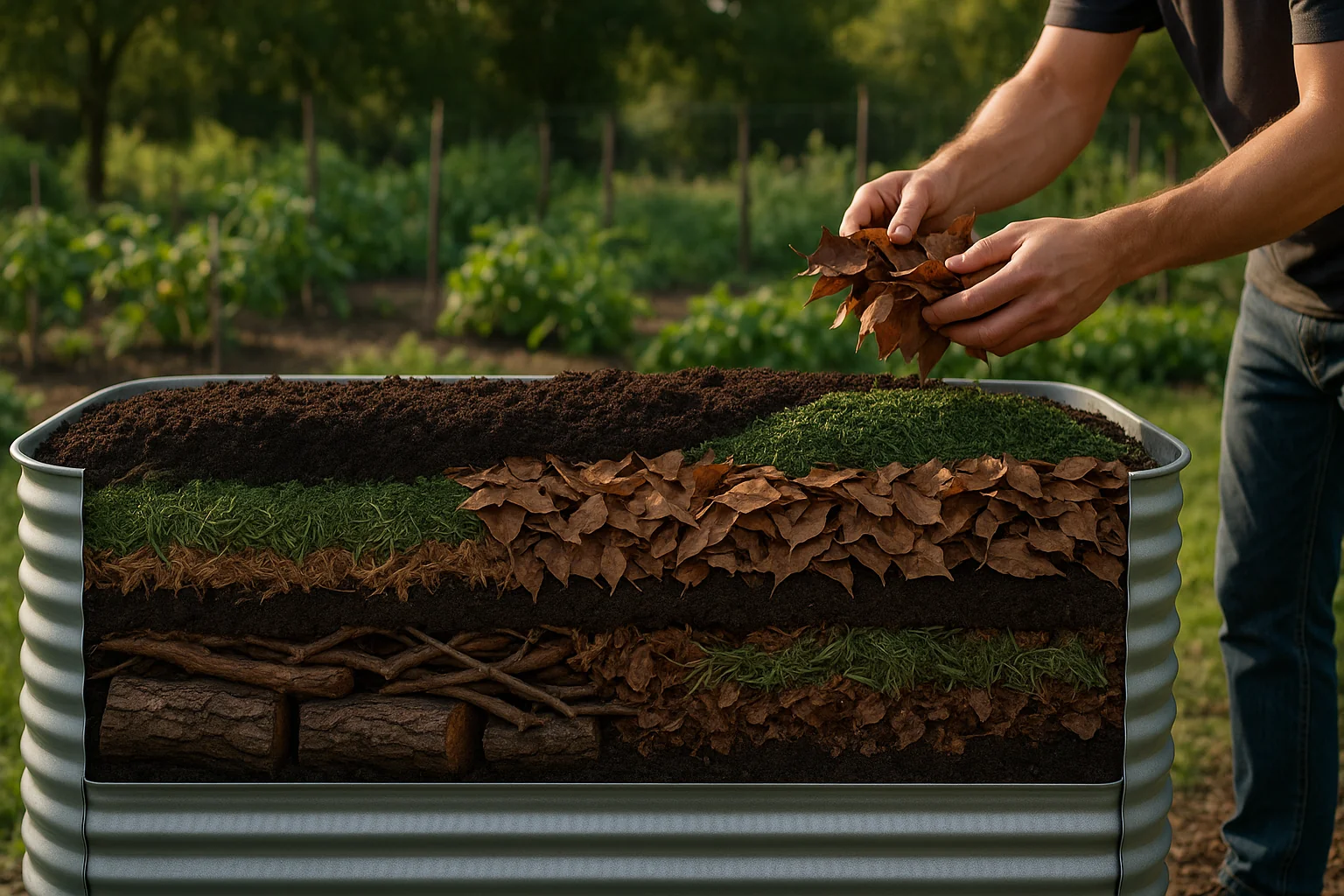
A tall raised bed is wonderful for your back. It’s brutal for your budget — if you fill it the way the bag-stacker at the garden center suggests.
A 4×8 bed at 29 inches needs roughly 77 cubic feet of fill. At big-box prices of $7–9 per cubic foot for bagged garden soil, that’s well over $600 per bed. We’ve talked to readers who have spent more on soil than on the bed itself.
There’s a better way. Here’s exactly how we fill our tall beds for around $200 each — and why the resulting soil is better than a bed packed with bagged Miracle-Gro.
The layered approach
Think of a tall raised bed as a slow compost pile with a vegetable garden growing on top.
We use a three-layer system loosely based on hugelkultur, a German technique of burying wood and organic matter under garden soil. The bottom layers decompose over years, slowly releasing nutrients and improving water retention while you grow above them.
If you’re new to raised beds entirely, start with our companion guide: our review of the four best raised garden beds for 2026. It covers which beds are worth the money before you start filling.
Bottom layer (the cheap-but-bulky layer)
The bottom 40% of a tall bed should be rough, woody, free organic matter. This is where you save the most money.
Good options:
- Untreated wood logs, branches, and brush
- Cardboard (remove tape, no glossy print)
- Dry leaves from last fall
- Pine cones, twigs, hedge clippings
- Old straw or hay (free if you ask a local horse farm)
What to avoid:
- Pressure-treated lumber, painted wood
- Walnut wood (allelopathic — kills tomatoes)
- Anything still chemically treated
Pack this layer loosely. A few air gaps are fine — they’ll compact naturally in the first few months.
Middle layer (the slow-release layer)
The middle 30–40% is half-finished compost, manure, and green material. This is the engine of your bed for the next two to three years.
Good options:
- Aged horse or chicken manure
- Half-finished compost (still chunky, not yet crumbly)
- Grass clippings (in thin layers, never thick mats)
- Spent mushroom compost
- Coconut coir (for water retention — we use a FibreDust block for every bed)
This is also where you can use cheaper “garden soil” from a landscape supply yard. Don’t pay bagged-soil prices for material that’s going 18 inches below your roots.
Top layer (the spend-here layer)
The top 8–10 inches is where 95% of vegetable roots actually live. This is where you spend your money.
Our top layer mix:
- 50% finished, screened compost
- 30% topsoil or coco coir base
- 20% perlite or coarse sand (for drainage)
We use Coast of Maine Castine Blend for the compost component. It’s roughly twice the price of generic big-box compost but completely finished, pH-balanced, and consistent batch-to-batch. For a bed you’re planting in next week, finished compost is worth the premium.
A realistic cost breakdown
For a 4×8×29” bed (~77 cubic feet):
| Layer | Volume | Source | Cost |
|---|---|---|---|
| Bottom (logs, leaves, cardboard) | 30 cu ft | Free | $0 |
| Middle (bulk compost + coir) | 30 cu ft | Bulk yard + coir blocks | ~$80 |
| Top (finished compost mix) | 17 cu ft | Bagged premium compost | ~$120 |
| Total | 77 cu ft | ~$200 |
Compare to $600+ for an all-bagged-mix fill.
Mistakes to avoid
- Don’t skip the cardboard layer at the very bottom. Bermuda grass and quack grass will laugh at your raised bed without it.
- Don’t pack the middle too tight. You want some air spaces for water to flow and microbes to work.
- Don’t use fresh manure in the top layer. Aged at least 6 months, or you’ll burn seedlings.
- Don’t use lawn clippings if you treat your lawn. Residual herbicide will stay active in grass clippings for months and devastate tomatoes and beans.
What happens in year two
The bottom layers compact and decompose. You’ll lose 4–8 inches of height in the first year. This is normal and good — what’s happening is the wood is rotting into rich soil and the compost is finishing.
Each spring, top off with 1–2 inches of finished compost. After about three years, the entire bed becomes uniformly rich, deep, drainage-perfect garden soil that you couldn’t buy at any price.
Final note
The first fill is a one-time hassle. After that, it’s just topping up. Pick the right bed (see our roundup), fill it smart, and your raised bed will out-produce in-ground gardening for the next decade.
Our Top Picks

Coast of Maine Castine Blend Compost (1 cu ft bag)
The compost we use for the top 8 inches of every bed. Lobster, alfalfa, and aged manure base, fully finished, no nitrogen burn. Worth the premium over big-box generic compost.

FibreDust CoCo Mulch 5kg Block (Coconut Coir)
Compressed coir block rehydrates to roughly 75 liters. We use it to bulk up the middle layer of tall beds — far cheaper than buying that volume in soil, holds water beautifully, and is pH-neutral.